Selected Work

These are examples of when organisations and leaders bring us in—typically at moments where existing strategy, governance, and leadership models no longer hold under transition conditions.
The following examples show how this work materialises inside real organisations.

When to hire us 

We work with organisations advancing business strategy towards long-term human and planetary health—and enterprise viability—by integrating environmental and human-capital realities into governance, leadership, and strategic decision-making.

What we do 

We redesign decision logic so business acts in alignment with how human and planetary systems actually function—through commerce.

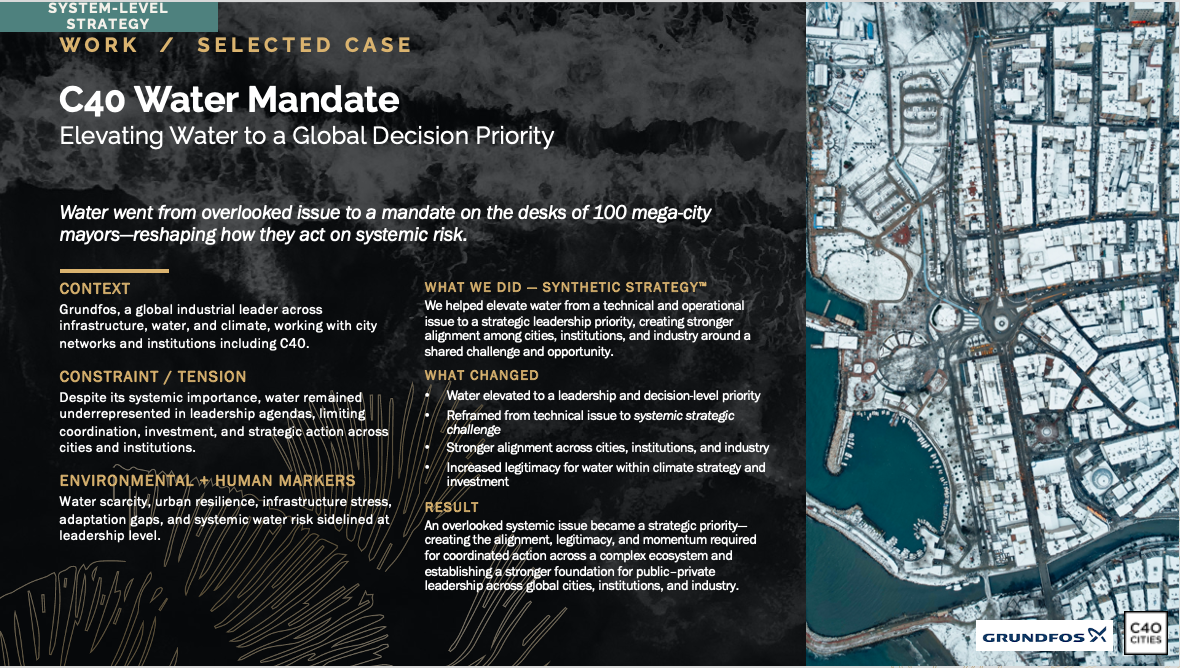
C40 Water Mandate — Elevating Water to a Global Decision Priority

We moved water from an overlooked issue to a global mandate—shaping how cities and major actors act on systemic risk.

Context
Global industrial leader (Grundfos) operating at the intersection of infrastructure, water systems, and climate—engaging with global city networks and institutions such as C40.

Constraint / tension
Water was materially critical yet structurally undervalued in global climate agendas. Despite its role in resilience, cities and institutions did not treat water as a core strategic priority—limiting coordinated action and investment.

Environmental + human markers
Water scarcity, urban resilience, infrastructure stress, climate adaptation gaps, institutional misalignment, and low prioritisation of systemic water risk at leadership level.

What we did – Synthetic Strategy
Positioned water as a systemic risk and strategic lever within the climate transition narrative; shaped the agenda-setting effort with C40 through Grundfos; aligned stakeholders across cities, institutions, and industry; supported leadership positioning and messaging; integrated water into broader climate transition frameworks to ensure relevance at decision-making level.

What changed

  • Water was placed on the global agenda within C40 for the first time
  • Shift from viewing water as a technical issue to a systemic climate priority
  • Stronger alignment across cities, institutions, and industry actors
  • Increased legitimacy for integrating water into climate strategy and investment decisions

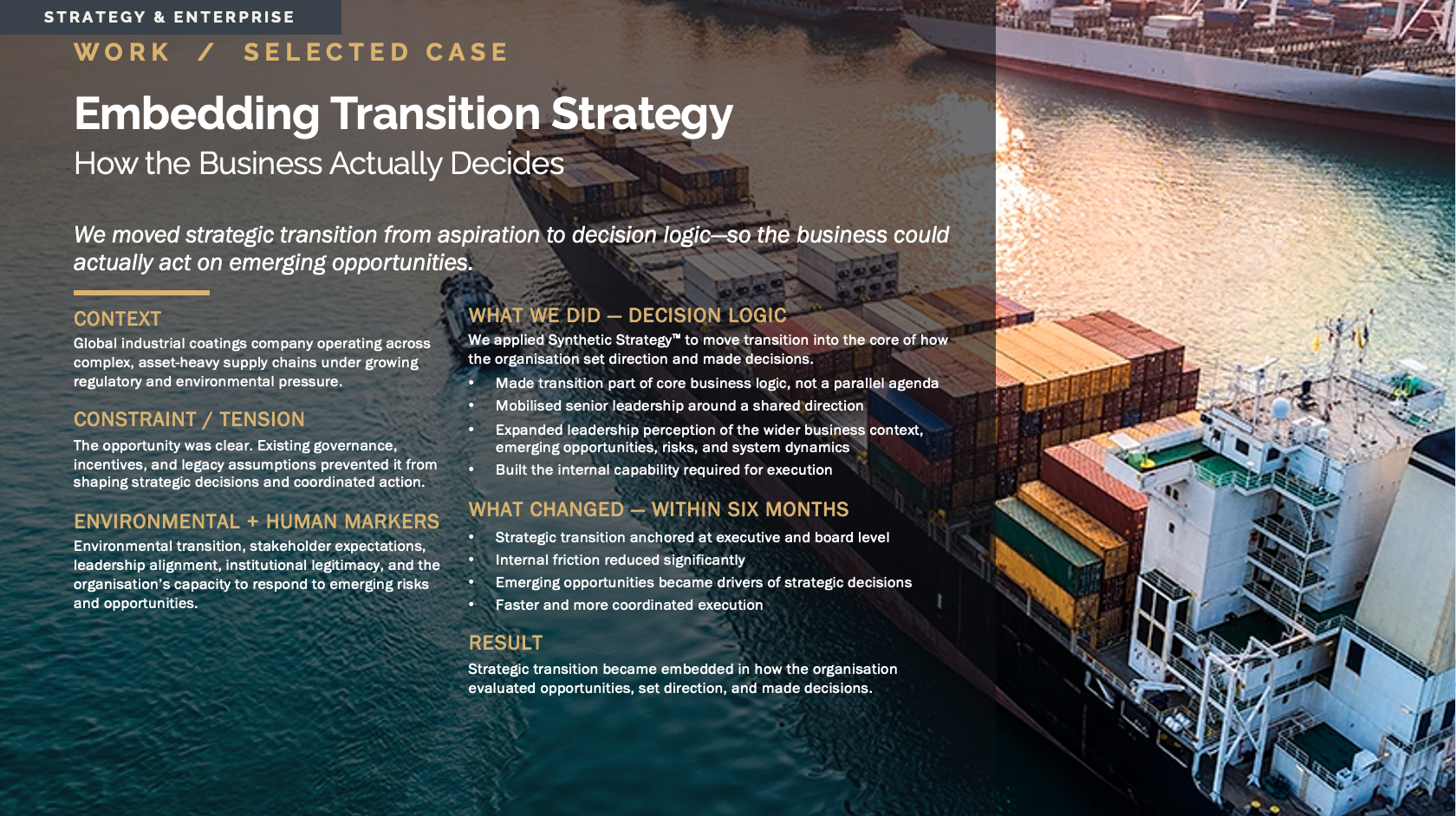
Hempel — Embedding Transition Strategy into How the Business Actually Decides
We moved sustainability from aspiration to decision logic—so the business could actually act on it.

Context
Global industrial coatings company operating across complex, asset-heavy supply chains under growing regulatory and environmental pressure.

Constraint / tension

The ambition was clear: integrate environmental and human realities into business strategy.
But existing structures — silos, incentives, governance — prevented these priorities from shaping real decisions at board and executive level.

What we did

We defined how sustainability would be integrated into the core of the business—by setting the strategic framework (synthetic strategy) and designing the leadership activation required to engage the organisation.

We operationalised this through:

  • Translating environmental and human constraints into core business logic
  • Shaping the key decision points and leverage across the organisation
  • Designing and facilitating a targeted leadership engagement (VP Challenger team) to activate ownership
  • Bringing together the capability required to deliver and scale the transition effort
  • Enabling the pathway for embedding transition priorities into governance and decision-making processes

What changed
Within six months:

  • Transition strategy became anchored at executive and board level
  • Internal friction dropped significantly
  • Environmental and human factors became drivers of decision-making
  • Faster, clearer, more effective execution across the organisation

Result: Sustainability moved from narrative to operational reality.


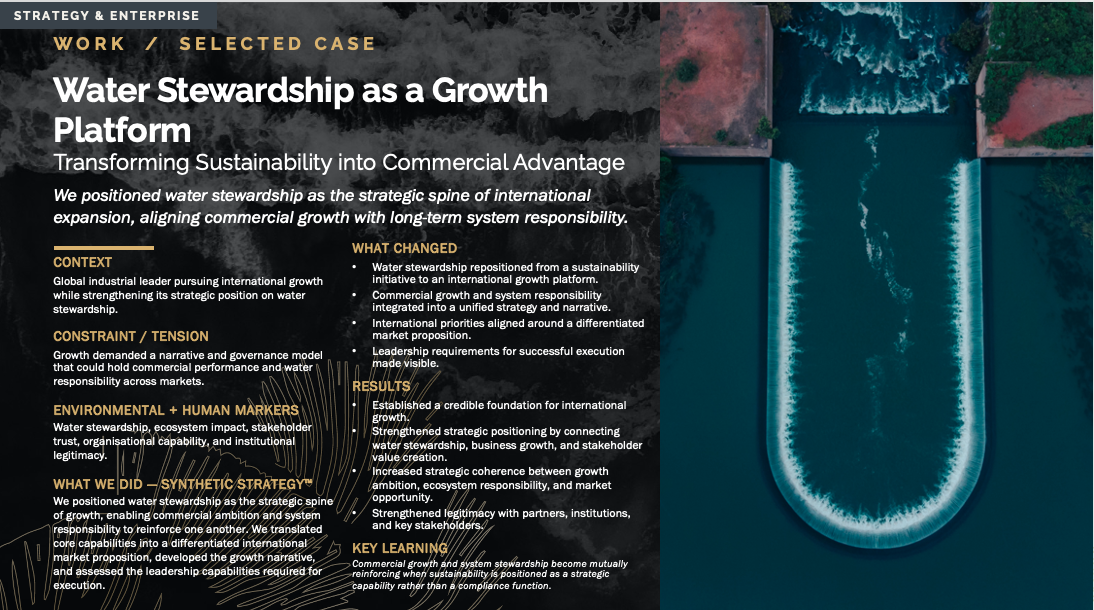
Grundfos  Water Stewardship + Commercial Growth Narrative for a Global Industrial Leader

Context
Global industrial company scaling internationally while strengthening positioning on water stewardship.

Constraint / tension
Growth ambitions required a narrative and governance model that could hold commercial performance and water-system responsibility credibly across markets and stakeholders.

Environmental + human markers
Water stewardship, ecosystem impact, stakeholder trust, capability gaps inside the organisation, and legitimacy with partners/institutions.

What we did – Synthetic Strategy
Developed strategic positioning and messaging that integrated water stewardship into enterprise strategy; supported leadership alignment; engaged stakeholders; identified internal competency gaps required to make the ambition executable; supported external communication and international media strategy.

What changed
A more coherent, credible platform for international growth—where the water agenda was not a “CSR layer” but integrated into strategy, leadership, and market positioning.


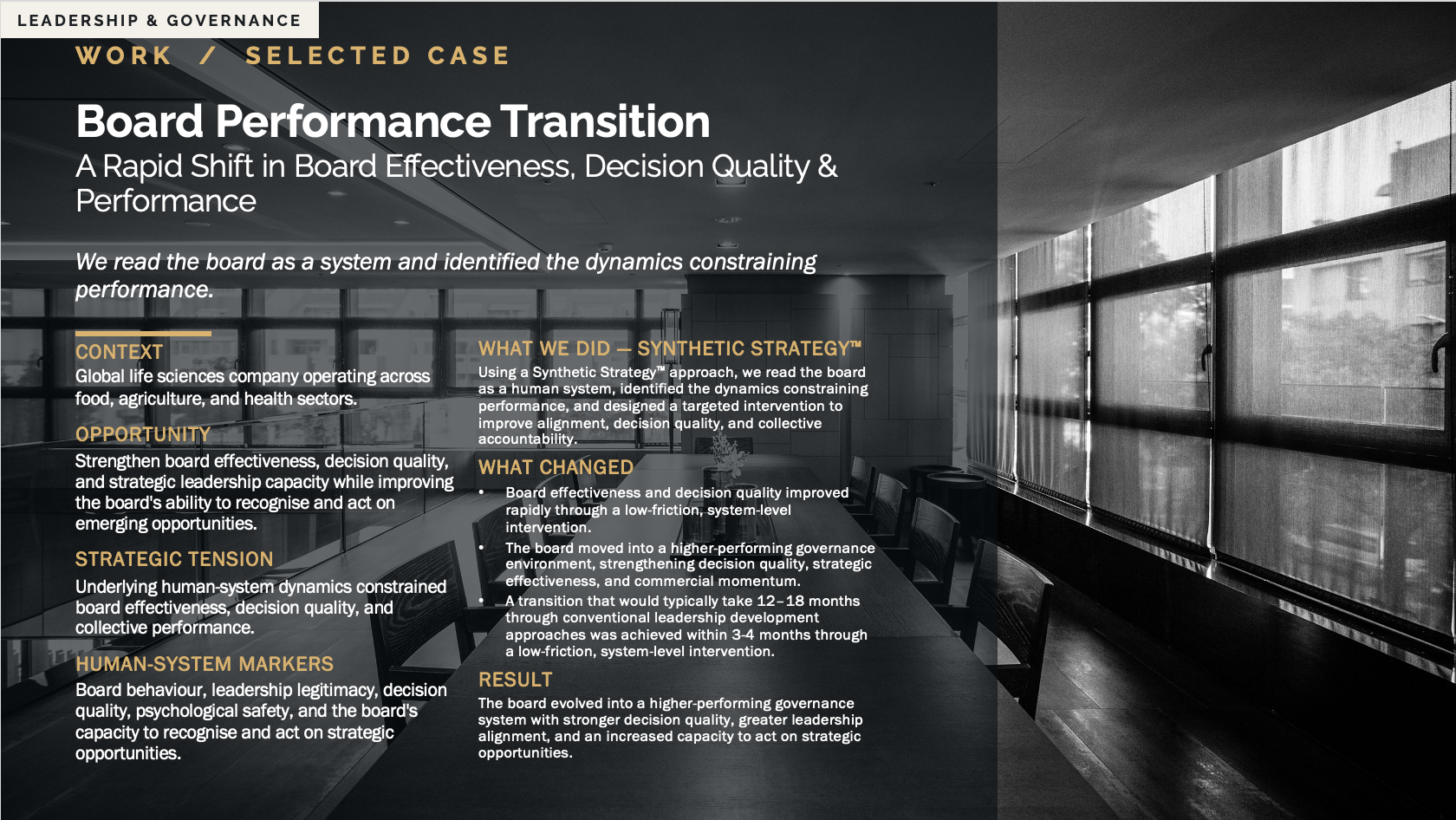
Chr. Hansen — Board‑Level Performance Transition Under Human‑System Constraint

Context
Global biotech company producing enzymes and probiotics for food, agriculture, and health systems. Public company with a high‑profile board, including the first female Chair of a Danish C20 company.

Strategic tension
Board performance was under strain as leadership dynamics, unconscious bias, and legacy power behaviours created friction at the top table. Left unaddressed, this risked impaired decision‑making, relational breakdown, and commercial underperformance—at a time when the company’s role in food, agricultural, and human health systems demanded strategic clarity and speed.

Human‑system markers
Board behaviour, leadership legitimacy, psychological safety, power dynamics, and collective decision quality as determinants of enterprise performance and long‑term viability.

What we did – Synthetic Strategy
Engaged by the CEO to rapidly shift board performance without direct intervention, confrontation, or individual coaching. Using a synthetic strategy approach, we mapped the board as a human system, identified leverage points for behaviour change, and designed a transition arc that redirected operating dynamics towards alignment with business objectives and human‑capital requirements. Behavioural change markers were introduced indirectly via the CEO, embedding expectations for healthy, high‑performance decision‑making at board level.

What changed
Board behaviour and decision quality shifted within months, avoiding relational rupture, loss of face, or prolonged governance disruption. The board moved into a healthier, higher‑performance operating mode, protecting commercial momentum and strategic viability. A transition that would typically take 12–18 months using conventional leadership development approaches was achieved within three-four months through low‑friction, system‑level intervention.


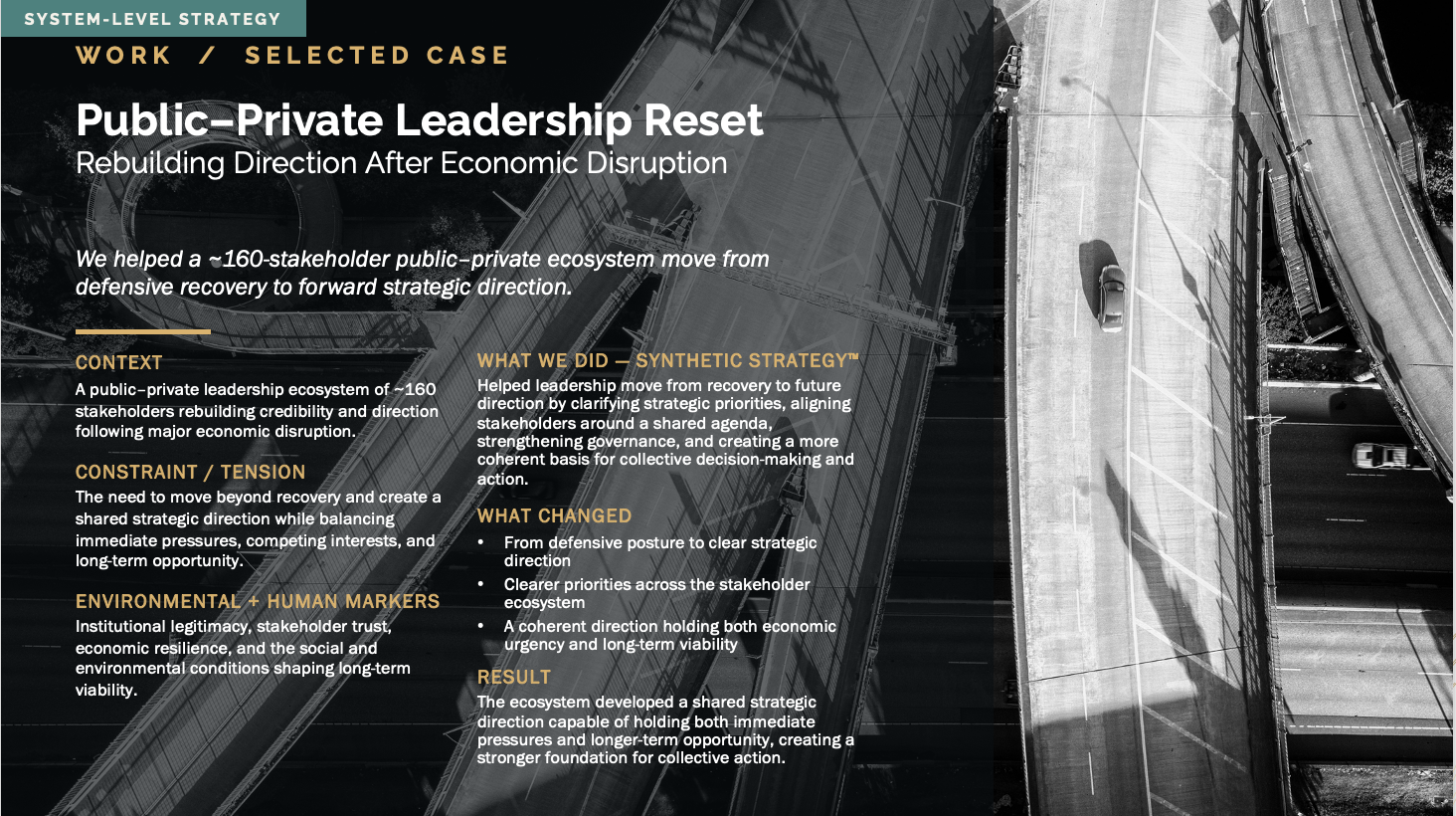
Public–Private Leadership Reset After Economic Disruption

Context
Public–private leadership ecosystem (~160 stakeholders) rebuilding credibility and direction following major economic disruption.

Constraint / tension
The system needed to move from reputational recovery to forward strategic positioning—while facing short‑term economic pressure alongside long‑term viability constraints.

Environmental + human markers
Livability, social trust, institutional legitimacy, and long‑term ecological and economic resilience.

What we did – Synthetic Strategy
Built a decision‑ready transition process: clarified strategic intent, translated sustainability/SDG markers into strategic pathways, aligned cross‑stakeholder leadership narratives, and established governance for prioritisation and execution.

What changed
Leadership shifted from defensive posture to strategic direction, with clearer priorities and a coherent transition narrative that could hold both economic urgency and long‑term viability.


Global Brand Strategy Under Cultural Constraint (HQ vs Nordic Markets)

Context
Large multinational implementing a multi‑year operational strategy across global markets; Nordic markets required a distinct trust and legitimacy logic.

Constraint / tension
A one‑size global strategy was eroding local credibility and reducing traction—especially under increased expectations for responsible business conduct.

Environmental + human markers
Social licence, trust formation across cultures, leadership behaviour under pressure, and responsible market presence.

What we did
Advised on strategic communication and leadership alignment to translate global ambition into culturally coherent market execution; supported crisis‑context leadership capability; reframed narrative to hold responsibility and commercial clarity simultaneously.

What changed
Improved market credibility and leadership coherence, with a clearer approach to operating responsibly across culturally distinct contexts without fragmenting enterprise strategy.


International Market Entry Where Strategy Did Not Travel (Scandinavia)

Context
US‑based company with global success entering Scandinavian markets.

Constraint / tension
Existing positioning and partnerships underperformed because the company misread cultural expectations and trust dynamics in a market with different norms around credibility and responsibility.

Environmental + human markers
Trust, legitimacy, stakeholder expectations, and leadership behaviour as an execution variable (not a “soft” factor).

What we did – Communication as architecture
Reworked positioning, partnerships and strategic communication; integrated cultural intelligence into leadership decision-making; supported relationship architecture and PR strategy with institutions and partners.

What changed
Market entry moved from reactive recalibration to intentional strategy, with stronger partnership traction and a clearer path to sustainable growth in the region.


Strategy Stalled by Leadership Narrative and Organisational Behaviour

Context
Purpose‑driven company with strong offering but stalled growth and partnership traction.

Constraint / tension
Self‑defeating executive perceptions and internal language created structural friction: misalignment between values, strategy, and external credibility.

Environmental + human markers
Human systems: leadership behaviour, culture, psychological safety, trust; commercial viability as a function of coherence and credibility.

What we did
Identified narrative constraints as a governance and strategy issue; reset leadership language and decision framing; aligned culture, positioning and business strategy into a coherent growth narrative.

What changed
Increased external clarity and credibility, improved leadership coherence, and a strengthened platform for growth and partnerships.


Multi‑Stakeholder Leadership Learning (Academia)

DIS – Study Abroad in Scandinavia (Academic programme, Denmark)

Context
Academic leadership programme (~300) operating across business, leadership and diversity domains.

Constraint / tension
Diversity and inclusion outcomes required more than information—bias and culture dynamics needed structured learning that translated into leadership practice.

Environmental + human markers
Human systems: bias, inclusion, leadership behaviour, learning across cognition/emotion/somatic intelligence; organisational culture as performance infrastructure.

What we did
Designed and delivered academically grounded, practice‑based learning integrating research, cases and guest expertise; ensured learning translated into leadership application rather than abstract knowledge.

What changed
Higher engagement and applied capability development—shifting learning from “content” to behavioural and leadership practice.


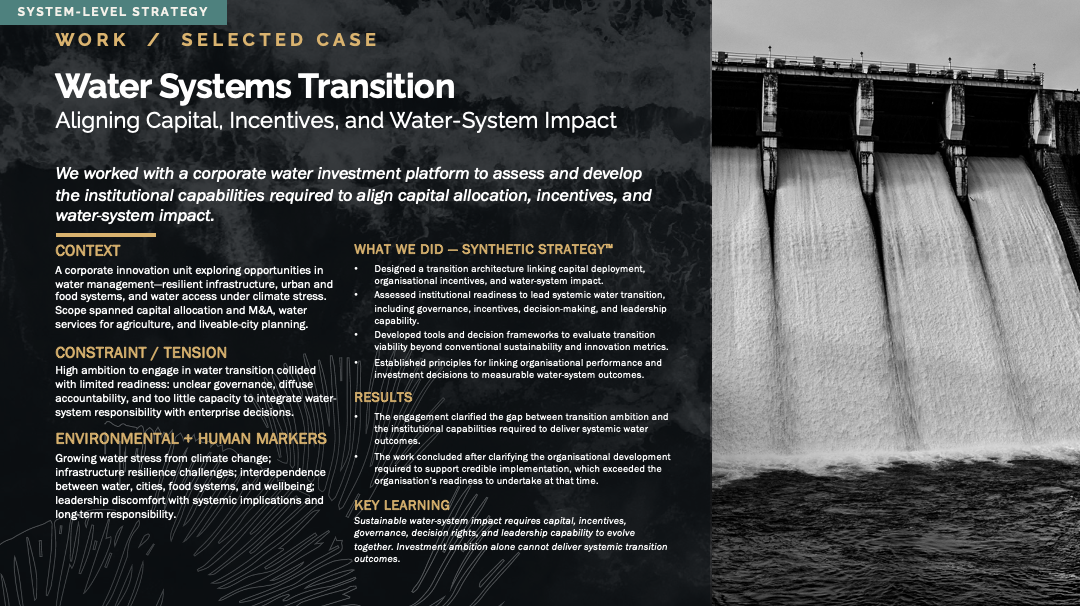
Water Systems Transition in a Corporate Innovation Unit

(Organisation anonymised)

Context
Corporate innovation unit exploring future‑oriented opportunities in water management, including resilient water infrastructure, sustainable urban systems, food systems, and access to water under increasing climate stress.

Constraint / tension
High ambition to engage in water‑related transition collided with limited organisational readiness: unclear governance, diffuse accountability, and insufficient capacity to integrate water‑system responsibility with enterprise decision‑making.

Environmental + human markers
Growing water stress driven by climate change; infrastructure resilience challenges; interdependence between water, cities, food systems, and human wellbeing; leadership discomfort with systemic implications and long‑term responsibility.

What we did
Applied synthetic strategy to integrate water‑system dynamics with business models, governance, leadership behaviour, and incentive structures; surfaced decision conflicts between innovation ambition and organisational capacity; translated complexity into coherent transition pathways grounded in water system viability rather than isolated initiatives.

What changed
The work clarified that credible engagement with water systems requires more than innovation rhetoric: it demands governance maturity, accountability, and readiness to carry long‑term consequences for both human and planetary systems. The engagement concluded once it became clear these conditions were not present. Key Learning: Synthetic transition strategy breaks down when organisations seek insight without the governance maturity to accept truth and act on it responsibly.


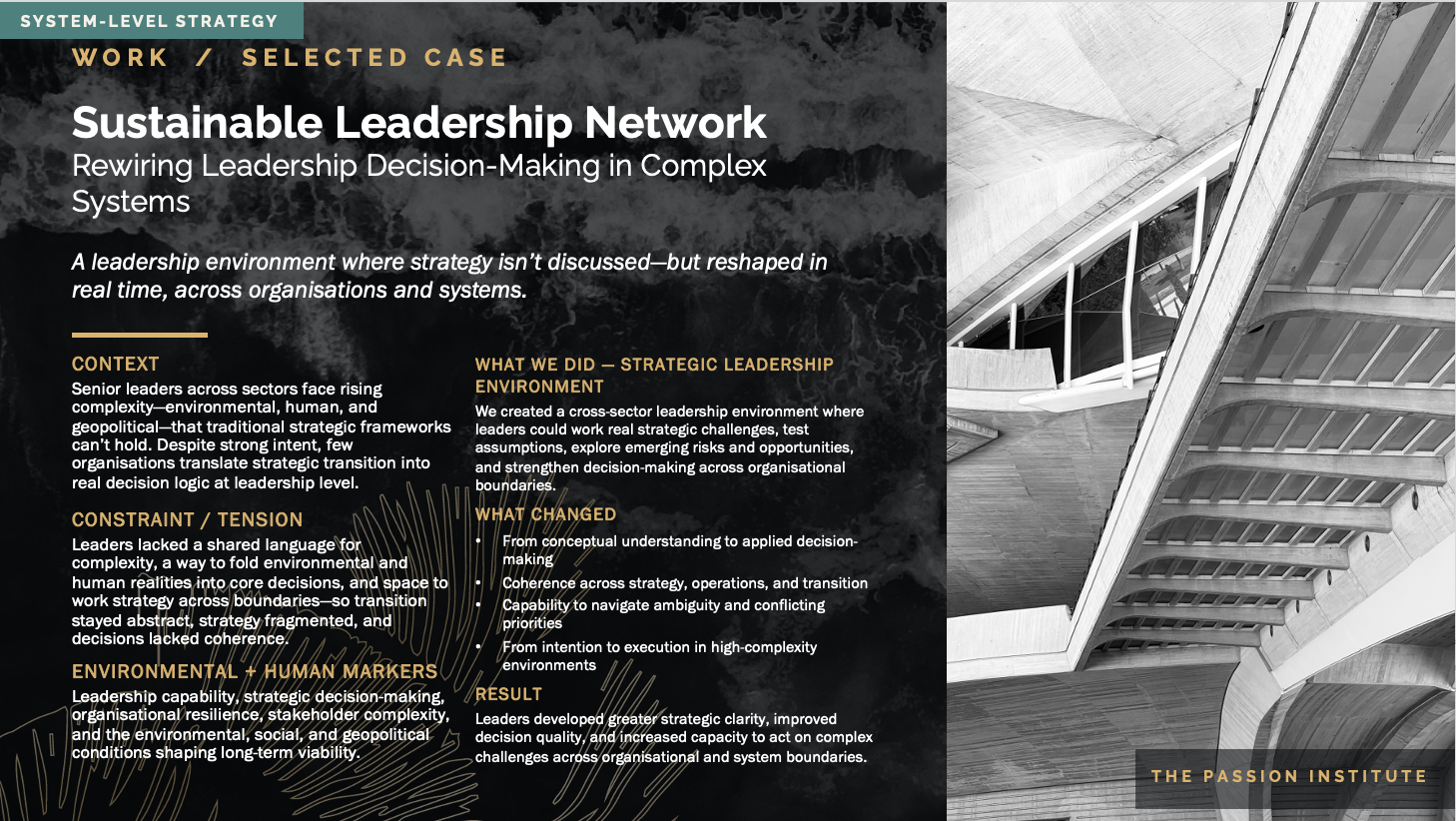
Sustainable Leadership Network — Rewiring Leadership Decision-Making in Complex Systems
We created a leadership environment where strategy is not discussed — but reshaped in real time, across organisations and systems.
Context
Senior leaders across sectors are facing increasing complexity environmental, human and geopolitical — that cannot be addressed within traditional strategic frameworks. Despite strong intent, most organisations struggle to translate sustainability and transition into actual decision logic at leadership level.
Constraint / tension
Leaders lacked:
  • a shared language to navigate complexity
  • the ability to integrate environmental and human realities into core decisions
  • a space where strategy could be worked on across organisational boundaries

As a result:

  • sustainability remained abstract
  • strategy remained fragmented
  • decisions lacked coherence
What we did
We designed and built Sustainable Leadership Network as a live strategic environment, grounded in synthetic strategy:
  • Brought together senior leaders across organisations and sectors
  • Introduced new strategic logic integrating business, human, and environmental constraints
  • Created a working space where leaders engage directly with real decisions and tensions
  • Enabled cross-organisational alignment and pattern recognition
  • Anchored reflection in real-world strategic challenges
  • Maintained continuity to ensure learning translated into action

What changed

  • Leaders shifted from conceptual understanding → applied decision-making
  • Greater coherence across strategy, operations, and sustainability agendas
  • Increased capability to navigate ambiguity and conflicting priorities
  • Stronger alignment across organisations working within shared systems
  • Movement from intention → execution in high-complexity environments

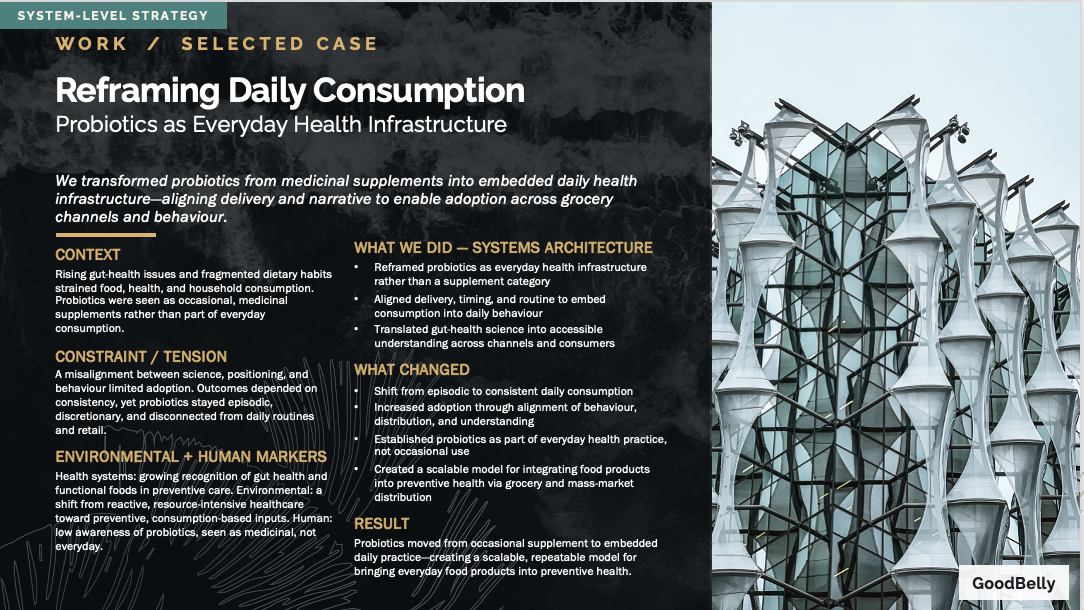
Goodbelly Food & Health Systems — Reframing Daily Consumption Through Probiotic Infrastructure

We transformed probiotics from medicinal supplements into embedded daily health infrastructure, aligning delivery systems and narrative architecture to enable adoption across grocery channels and consumer behaviour.

Context
Rising chronic health issues linked to gut health, combined with fragmented dietary habits, were creating systemic strain across food, health, and household consumption patterns. Probiotics were positioned as occasional supplements and medicinal in nature, rather than embedded in everyday consumption.

Constraints / tension
A misalignment between scientific understanding, product positioning, and consumer behaviour limited adoption. Health outcomes depended on consistency, while probiotics remained episodic, discretionary, and disconnected from daily routines and retail structures.

Environmental + human markers
Health systems: increasing recognition of gut health and functional foods as part of preventive care. Environmental systems: transition from reactive, resource-intensive healthcare towards preventive, consumption-based health inputs, reducing long-term system pressure. Human systems: low awareness and understanding of probiotics, perception as medicinal rather than integrated health behaviour, fragmented consumption patterns.

What we did
Reframed probiotics as daily health infrastructure rather than a supplement category.
Designed a direct-to-household delivery model to embed consumption into routine.
Aligned product, timing, and distribution to reduce friction and anchor behaviour.
Shaped the narrative architecture — translating the science of gut health and functional foods into accessible understanding, enabling adoption across stakeholders, retail channels, and consumers.

What changed
Shift from episodic to consistent daily consumption.
Increased adoption through alignment of behaviour, distribution, and understanding.
Established probiotics as part of everyday health practice rather than occasional use.
Created a scalable model for integrating food products into preventive health systems via grocery channels and mass-market distribution.


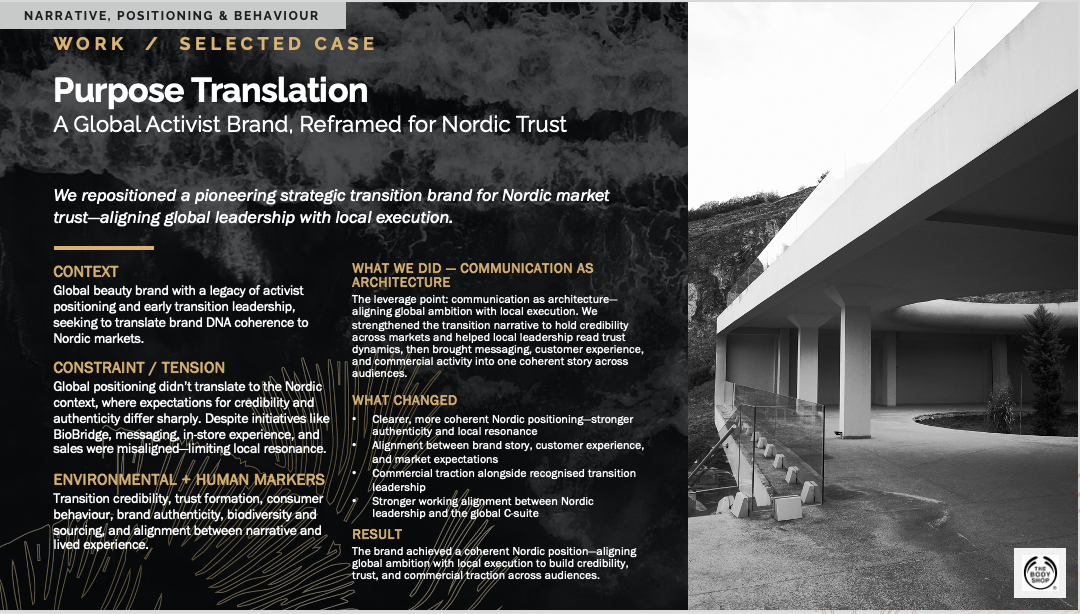
The Body Shop — Cultural Translation of a Global Activist Brand (Nordic Markets)

Repositioned a pioneering sustainability brand for Nordic market trust—aligning global leadership and local execution

Context
Global beauty brand with a legacy of activist positioning and early leadership in sustainability, seeking to strengthen relevance in Nordic markets.

Constraint / tension
Global brand positioning and initiatives did not translate effectively into the Nordic context, where expectations for credibility, authenticity, and responsible business conduct differ significantly.
Despite strong sustainability initiatives (e.g. biodiversity programmes such as BioBridge), there was a misalignment across messaging, in-store experience, and sales approach—resulting in limited resonance with local consumers.

Environmental + human markers
Sustainability credibility, trust formation, consumer behaviour, brand authenticity, biodiversity and sourcing practices, alignment between narrative and lived brand experience.

What we did – Communication as architecture
Worked directly with the global executive team to clarify and strengthen the strategic direction of the sustainability narrative—ensuring it could hold credibility across different market contexts.

Supported Nordic senior leadership in understanding local trust dynamics and the gap between global intent and market perception.

Aligned global ambition and local execution by identifying and prioritising the narrative angles that could credibly position The Body Shop in the region.

Opened dialogue across global and regional teams on inconsistencies in packaging, campaign messaging, and overall brand expression—surfacing areas where dissonance weakened credibility, and addressing these with sensitivity to brand legacy and internal alignment.

Reshaped messaging, in-store experience, and sales approach to create coherence between sustainability positioning and customer experience.

Deployed a dual approach:

  • B2B: speaking platforms, media, and positioning within sustainable business discourse
  • B2C: in-store communication and media engagement

Focused on shaping narrative as a driver of both behaviour and brand perception.

What changed
A clearer, more coherent positioning for the Nordic market, strengthening authenticity and local resonance.
Improved alignment between brand story, customer experience, and market expectations—supporting The Body Shop’s ambition to be recognised as a leader in sustainable business practices while enabling commercial traction.

Increased resonance and working alignment between Nordic leadership and the global C-suite, strengthening shared understanding of how sustainability ambition translates into market reality.


UPCOMING EVENTS & WORKSHOPS

arrow2-01  Think Tank for Global Transition Leaders INDIA 2027 More here

arrow2-01  Strategic Clarity Session – a focused, low-commitment space for clarity and direction in complex transition decisions More here


arrow2-01 Work
Selected strategic transitions
[More →]


CONTACT

DK +45 4244 9800
M sandja@thepassioninstitute.com


The Passion Institute is a Refresh Agency company focused on conscious leadership training. | Terms of Service